
The Silent Boiler Killer - Boiler Scale
If your boiler is the heart of your facility, then water is the life blood of your boiler system and just like cholesterol and plaque plagues the human heart, hard water and boiler scale is a huge danger to your boiler. Common to many regions of Canada, the impact of hard water is the build up of boiler scale inside your steam boiler is significant. It’s the primary cause of overheating as well as failure of boiler tubes. How does it happen? Elements contained in hard water, like calcium and magnesium, form a rock hard buildup on the components and tubes of the boiler’s interior.
Why do these crusty, rock hard deposits of minerals in your boiler system pose such an issue for your boiler? Because they will make your system’s thermal efficiency lower significantly, boiler scale can lead to only 1/15 ~1/100 times normal thermal efficiency on water tubes leading to over all lower boiler efficiency. The mineral deposits insulate pipes which leads to poor heat transfer to water. Most dramatically, the overheating of water pipes will cause it to weaken in strength and expand leading to rupture and the possible critical failure of your boiler.
What is Boiler Scale?
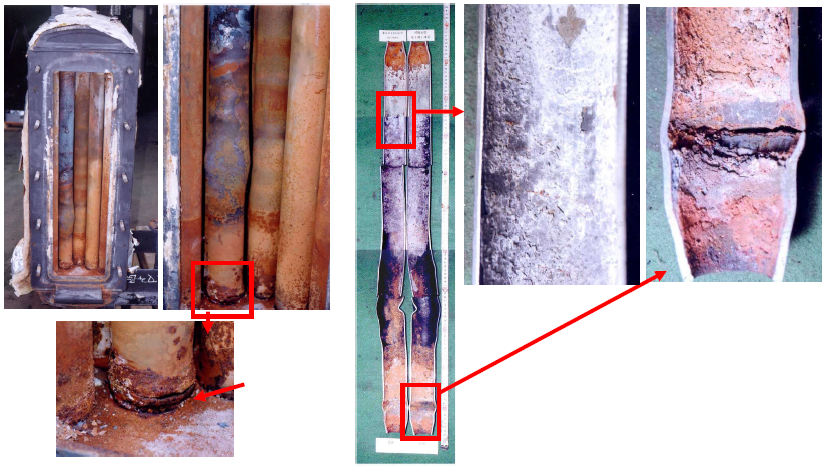
- Scale is a layer of solidification/calcification that forms on the surface of the boiler water tubes.
- Scale comes from hardness in water. When water evaporates (becomes steam), hardness gets left behind and can form scale.
- A layer of scale just an eighth of an inch in thickness can cause as much as 20%-25% in efficiency loss.
Examples of Boiler Scale
Water Hardness Basics
- When certain mineral compounds are present in your feedwater it is considered ‘hard’ specifically:
- Calcium Carbonate (CaCO3)
- Magnesium Carbonate (MgCO3)
- Other materials can combine with Ca, and Mg to create scale, such as Silica
(Si), Iron (Fe), Carbonate (CO3), Phosphates (PO4), Phosphonates, etc. - 85% of water in Canada and the USA is considered ‘hard’
- Water in Guelph, Kitchener, and Waterloo in Ontario, as well as Calgary, Red Deer and Edmonton has extremely hard water
- A Miura Water Quality Survey can tell you if your water is hard and what you can do about it contact us and our water treatment specialists can maker a site visit.
How can you deal with Hardness and Scale?
The issue of hard water and scale build-up is not a new one, and steam boiler manufacturers like Miura have been developing and perfecting ways to treat boiler feedwater for decades now. These innovations include a range of water treatments and sophisticated monitoring systems that alert steam boiler operators and integrated boiler operations to water hardness before scale build-up can even become an issue.
• Water Softeners which are designed to remove hardness and create Soft Water
• Scale Dispersing and Removing Chemicals; scale dispersing chemicals can prevent hardness from becoming scale through interaction with the hardness
• DO NOT use phosphate-type chemicals to remove scale or hardness
• Keep in mind, hardness may come back from the condensate line if process equipment fails and leaks back contamination, hard water, etc.
Miura's Water Treatment Solution
Treating hard water is one of the primary ways of preventing boiler scale. Miura’s MW dual-tank water softeners are vital components of any Miura modular steam boiler system. These water softeners look like large gas canisters but are filled with resin beads that capture dissolved solids, including CaCO3 and MgCO3, inside the canisters, preventing these compounds and minerals from entering the steam boiler feedwater system.
Chemical Treatments - Miura's Boilermate
BOILERMATE® 1200S is Miura’s all-in-one boiler water treatment. It’s a silica-based product that creates a protective layer of film on the water tube surface to protect against corrosion. It also includes a small dosage of scale dispersant that safeguards against the minute amount of hardness that conventionally leaks out of a water softener. BM1200S effectively treats hardness if used in a system with an active and effective water softener – i.e., BM1200S is not intended to handle large concentrations of hardness.
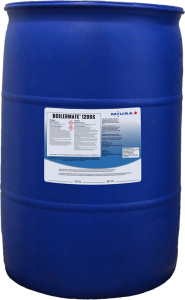
BOILERMATE® 2100D is MIURA’s “On-Line” scale scale remover and iron dispersant.
• Chelates scale off the water tubes by sequestering Calcium and Magnesium Ions.
• No need to stop the boiler like when performing an acid wash
• Also works to prevent scale formation at lower dosages, in case of small hardness leakage incidents
Hardness Detection
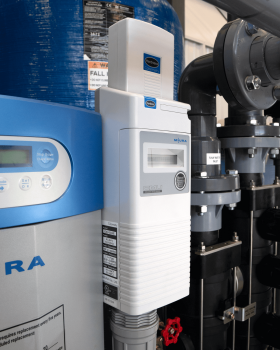
Routine testing for water hardness is essential for hardness damage in a steam boiler system. While it’s the responsibility of the boiler operator or owner to test periodically for water hardness, Miura’s Colormetry Hardness Detection System also assists with detecting and alerting operators to hardness leakages. The colormetry unit has been designed to sample and test pre-treated soft water at regular intervals. It can communicate results with other Miura components and notify the operators via its display that the action is required to prevent potential hard water damage to the steam boiler.
Control and Monitoring
Miura’s BOILERMATE® Chemical Monitoring System works together with the BL Micro Controller and Miura Online Maintenance (MOM) to regulate the amounts of chemicals being administered to help prevent the overuse of the products.
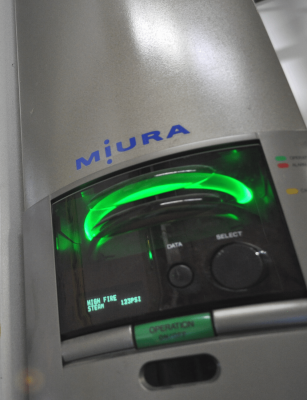
Each Miura boiler also comes fitted with a BL Micro Controller, a boiler control interface that allows operators to navigate the boiler control panel and, among other things, monitor the surface temperature of the water inside the boiler tubes for early scale build-up detection. Rising temperatures signal that scale formation in the boiler tubes needs the operator’s attention.
Scale formation in a steam boiler is both common and preventable. With the proper controls and measures in place, you can protect the inside of your pressure vessel, prevent any unnecessary and costly downtimes, maintain operational efficiency, and ensure the ongoing safety of your boiler room.
Share